
 English
  Español

In a world marked by uncertainty, rapid change, and growing complexity, agile methodologies have emerged as a powerful response to transform how organizations work, learn, and relate.
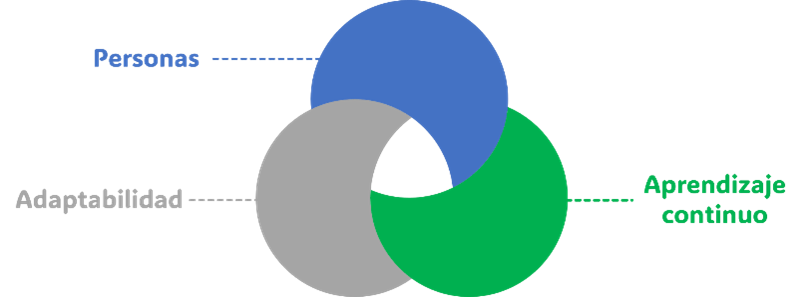
Beyond tools and technical frameworks, the heart of agility lies in three deeply human principles: prioritizing people, adaptability, and continuous learning.
People first: the soul of agility
Agile methodologies, from the original manifesto, place people above processes. This doesn’t mean disorder—it means recognizing that collaboration, trust, and motivation are the true drivers of change.
- Self-organized teams: Autonomy is encouraged so teams decide how to approach challenges, strengthening their sense of belonging.
- Constant communication: Agile ceremonies (like dailies or retrospectives) create spaces for listening, validation, and collective adjustment.
- Emotional recognition: Celebrating achievements, learning from mistakes, and caring for emotional well-being are essential practices to sustain team energy.
Adaptability: navigating change with purpose
Agility doesn’t seek to control the environment but to respond intelligently and flexibly. Instead of clinging to rigid plans, it values iteration, feedback, and the ability to adjust direction.
- Short, reviewable sprints: Allow testing hypotheses, correcting errors, and advancing with greater certainty.
- Dynamic prioritization: What matters today might not tomorrow—objectives are constantly reviewed and adjusted.
- Organizational resilience: Adaptability is not only technical but emotional. Agile teams learn to live with ambiguity and turn it into opportunity.
Continuous learning: growing while advancing
In agile environments, learning is not an isolated event but a daily practice. Each delivery, each feedback loop, each mistake becomes a source of knowledge.
- Meaningful retrospectives: Focus not only on what went wrong but on how to improve together.
- Culture of experimentation: Promotes trial and error as a legitimate path to innovation.
- Cross-training: Teams learn from one another, breaking silos and building shared capabilities.
Conclusion: agility with a human face
Adopting agile methodologies is not just about changing processes—it’s about transforming culture. It means recognizing that people are not resources but protagonists; that change is not a threat but a possibility; and that learning is not accumulation but evolution.
When an organization embraces these principles, it doesn’t just become more efficient—it becomes more alive.
